Steering gear
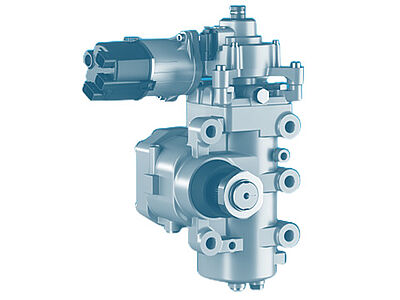
The steering gear is a key component of the steering system. It converts the rotational movement of the steering wheel into linear movement of the tie rods, which in turn steer the front wheels. This is how the vehicle is steered in the desired direction.
Function
The steering system enables the vehicle to be controlled precisely and safely. As part of that system, the steering gear converts the rotational movement of the steering wheel into a sliding movement of the tie rods. The tie rods transfer steering forces axially from the steering gear to the wheels or to the front axle steering knuckles/wheel carriers, causing the wheels to turn.
An important characteristic of the steering gear is its ratio: this describes how much the steering wheel movement changes the wheels’ steering angle. A high ratio makes steering easier and requires less effort, while a low ratio provides a more direct, sportier driving feel.
The two main types used today are rack and pinion steering and recirculating ball steering.
Rack and pinion steering
In rack and pinion steering, a pinion driven by the steering wheel engages with the helical teeth of the rack and moves it to the left or right according to the steering input. The rotational movement of the steering wheel is thus converted into a sliding movement of the rack and, consequently, the tie rods. The wheel carriers connected to the tie rods then turn the wheels. Rack and pinion steering is available with a constant or variable ratio and is standard in passenger cars.
Recirculating ball steering
In recirculating ball steering, a chain of balls converts the rotational movement via a screw element on the rack into a sliding movement of the rack: when the driver turns the steering wheel, the balls move through the threads. The tie rods connected to the rack transmit the steering input to the wheel carriers, which in turn turn the wheels. Recirculating ball steering is used mainly in commercial vehicles.
Almost all modern steering gears are combined with power assistance. In addition to conventional hydraulic power steering, electric power steering (EPS) is now widespread; it enables more precise control and helps improve efficiency.
While today’s vehicles mainly use rack and pinion or recirculating ball steering, the automotive industry is increasingly developing steer by wire systems. These replace the mechanical connection between the steering wheel and steering gear with electronic signal transmission. Electric motors execute the steering commands. Benefits include greater flexibility in vehicle architecture, lower weight and the ability to vary steering characteristics through software. Some production vehicles already use this technology in selected model ranges.
Safety
Together with the other steering system components, the steering gear must ensure safe and precise steering in all driving conditions. This requires zero play and high durability. It is also designed to absorb energy or deform in a controlled way in the event of an accident, reducing the risk of injury to occupants.
Suppliers
Here you can find all suppliers for the product "Steering gear":


Downloads
Here you can find all available downloads for the topic "Steering gear":
All file downloads: