Air suspension
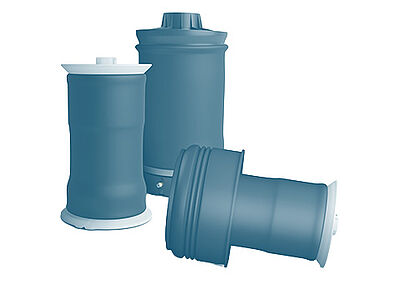
In modern vehicles, air suspension replaces conventional suspension with a system of air springs, compressors, valves and sensors. It allows ride height and spring stiffness to be adjusted continuously to suit different driving conditions. The result is a combination of high comfort, precise driving dynamics and ground clearance - tailored to demand, regardless of load or road surface.
Function
Passenger car air suspension replaces conventional steel springs with flexible air springs whose internal pressure determines the distance between the body and the axle. Pumping more air into the spring raises the vehicle; releasing air lowers it. Air pressure is controlled by a compressor and an electronic valve control system. Sensors continuously monitor vehicle level and load. This allows the suspension to stabilise the vehicle body and adjust its height automatically, or manually.
Air suspension systems are generally divided into open and closed systems.
In open systems, the compressor draws in ambient air, compresses it and feeds it directly into the air springs. When the vehicle is lowered, excess air is released into the surroundings. This design is technically simpler and less expensive, but the compressor has to run more often, resulting in higher energy consumption and more wear.
Closed systems, by contrast, retain compressed air within the system. They use a closed circuit and often include a reservoir that acts as a pressure accumulator. This allows air to be redistributed between the air springs and the reservoir without drawing in, or releasing, outside air. The result is faster response, quieter operation and lower energy consumption.
In both designs, the air springs, which are made from high- strength elastomer, are the central component. They perform the function of steel springs, while the valve block, sensors and electronic control system regulate pressure - and therefore ride height. Height and acceleration sensors continuously measure driving conditions, load and speed. A central control unit adjusts air pressure to suit the conditions.
Depending on the design, air suspension can automatically maintain a constant ride height (self - levelling) or it can be deliberately varied. At high speeds, the vehicle is lowered to improve aerodynamics.; Off-road, or under a heavy load, it is raised. Ground clearance is therefore not fixed, but a controllable parameter that adapts to driving conditions.
In many models, air suspension is also combined with an adaptive damping system. The interaction between variable spring stiffness and electronically- controlled damping provides an optimal balance between comfort and driving stability.
Safety
Air suspension contributes to driving stability and safety in several ways. Systems with automatic self -levelling keep the vehicle at an optimal height regardless of load, ensuring consistent axle loads and balanced handling. This improves driving stability and makes braking behaviour more consistent. In corners, air suspension reduces body roll; at high speeds, it lowers the body to reduce air resistance.
Simpler versions without automatic control at very least allow the ride height to be adjusted manually, for example, to improve stability when towing or carrying an uneven load. In off- road vehicles, the system can also raise the vehicle to increase ground clearance and protect the underbody.
Environmental protection
Lowering the vehicle on the motorway reduces air resistance and therefore energy consumption, in both combustion- engine vehicles and electric vehicles. Consistent ride comfort helps protect tyres and suspension components, reducing material wear and saving resources. Closed systems with a reservoir are also particularly energy efficient because the compressor needs to start less often.
Retaining vehicle value
By distributing loads evenly across all axles, air suspension reduces long- term wear on suspension and body components. Vehicles with air suspension are regarded as particularly comfortable and retain their value well. Regular maintenance is essential, however. Pressure loss, leaking lines or ageing air springs can cause malfunctions and reduce comfort. Because the design is more complex, repairs are more expensive than with conventional suspension, which is something that should be taken into account - especially for older vehicles.
Suppliers
Here you can find all suppliers for the product "Air suspension":


Downloads
Here you can find all available downloads for the topic "Air suspension":
All file downloads: